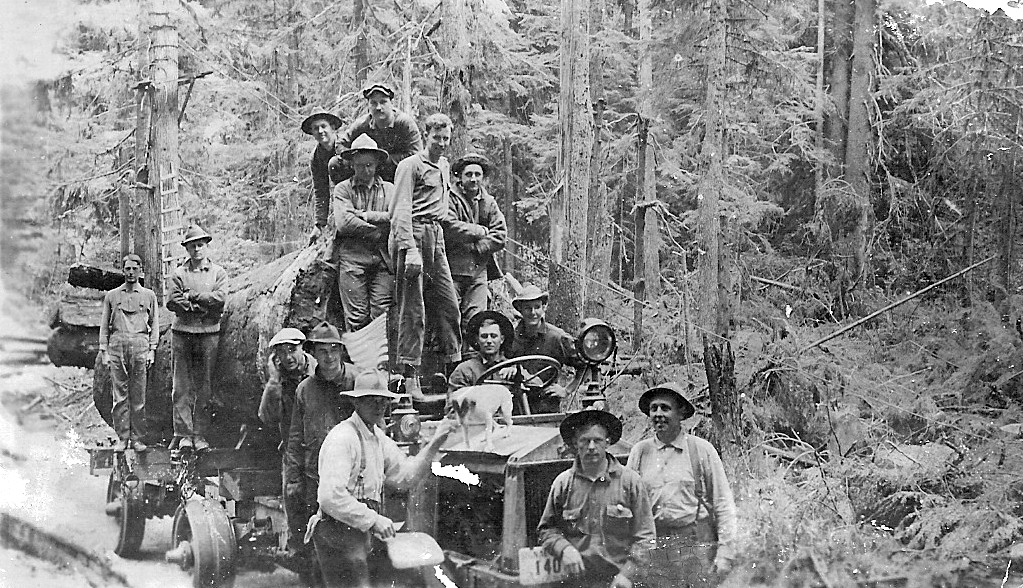
Spruce Soldiers on Logging Truck
Background
During my research on the First World War, I discovered a fascinating corner of American history that has been all but forgotten.
The states of Oregon and Washington form the backdrop for one of the most interesting dramas of the First World War. When the U.S. entered the War, it was quickly discovered that the nation had no capacity to build warplanes in quantity. Even though the U.S. had invented the airplane, by 1917 the European powers had already spent years developing it for warfare, and deploying it in deadly combat. Those nations were trying to produce enough machines to keep the skies occupied over the front lines in France. The lumber industry in the Pacific Northwest of the United States was supplying the Allies with spruce timber, vital to the construction of wing spars and other parts. As 1917 continued into 1918, the logging industry lost many men to the draft, and labor strife increased. These labor shortages caused the flow of aircraft spruce to nearly dry up.
The Army Steps In
The Army formed the Spruce Production Division (SPD) to increase the flow of airplane wood, by providing men to work in the forests and mills. Eventually, the use of Army men and equipment helped to greatly increase the production of spruce, fir, and cedar (all being used for airplane and ship production). A large contingent of Army men worked side-by-side with civilians in the forests and mills. (They were paid the same wages as the civilians, minus their Army pay.)
In addition, Army men built and worked in a special wood production plant at Vancouver Barracks. This “cut-up” plant provided wood ready for the airplane manufacturers, since most mills in the Pacific Northwest were not equipped to meet airplane specifications.
Finally, many Army men in the field built roads and railroads to reach the spruce stands along the Pacific coast. They even operated the railroads, and drove the log transport trucks. In the past, commercial loggers had paid little attention to these trees, and the stands were not accessible to existing roads.
Labor Issues
The Army confronted the labor strife by creating a quasi-union, the Loyal Legion of Loggers and Lumbermen (LLLL) Logging companies were required by the government to raise wages and provide better working conditions, with the LLLL providing a patriotic base for the non-striking workers. Agitators who opposed the LLLL and fomented labor strife were removed by the government from the lumber workforce.
The soldiers in the field worked directly for contractors, who were, for the most part, the existing lumber companies. The Army enforced minimum requirements for work hours, lodging, and food, which in most cases exceeded anything seen before in the woods. In some cases, soldiers built their own barracks as part of the camp construction, while others lived in tent cities, much like a military base. Soldiers working at mills near towns were often lodged in local hotels.
Army Organization
The soldiers of the Spruce Squadrons were initially in the Signal Corps, since it was this organization that began and oversaw all Army aviation. The term “squadron” would normally be applied to a flying group, but it was also used for these small construction and logging units. Many of these soldiers were itching to go “over there” and take part in the real fighting, but their labor was needed in Oregon and Washington.
It should be noted that many of the soldiers working for the Spruce Production Division were “limited-service” men, those who did not meet the physical standards for combat. Much like the soldiers who were trained at Camp Syracuse, New York, these men would probably have been put into the U. S. Guards, an Army organization that guarded bridges, shipyards, mines, etc. within the U. S.
By November, 1918, about 28,000 soldiers, many of whom were working with about 100,000 civilians, were stationed in the Pacific Northwest. Of that total, about 18,000 soldiers were engaged in logging, construction, and mill work in the field (in about 235 camps) with the civilian lumbermen.
Another 4,000 of the total worked at the cut-up plant in Vancouver. Finally, an additional 4,000 men were permanently located at Vancouver Barracks, both to help with infrastructure (supply, HQ operations, etc.) and as an armed force necessary to maintain peace in the volatile labor environment of the logging industry. Some of these men also helped control forest fires in the Northwest during 1918.
Isolation
The Spruce soldiers in the field were often housed in small camps located far from towns, and often far from any communications at all (no Post Offices, no roads, no railroads, not even telephone or telegraph). The Army historical division lists the towns where these soldiers might have been located in the Order of Battle book (also available on CD-ROM). Much better information is available in the excellent book Soldiers in the Woods by the late Rod Crossley (who passed in 2019). (Search for this book on Amazon or ABEBooks
The book was formerly described at timbertimes.com, a website that is no longer working.)
Information in Crossley’s book shows that it is quite a challenge to identify a specific location for any one spruce soldier or group. Not only that, but Army units and sub-units were often transferred as the logging and construction work was finished, or new projects started.
Postal History
Postal history (which I collect) is often found for the soldiers working at Vancouver Barracks, since this was a large, fixed facility. Letters and cards from the soldiers in the isolated logging camps are considerably less common. By comparison, far more postal history material is seen from the soldiers at a major Army training camp (such as Camp Devens), even though the total population of soldiers in Washington and Oregon was about the same as the population of that single camp.
Availability of Rosters
Note that while I have a few spruce camp unit rosters , for the most part I cannot connect a particular soldier with a particular unit. (Some of the rosters were generously provided by collectors and relatives of Spruce Soldiers.) Feel free to view the rosters that I do have posted. If you know the name of a soldier who may have served in the First World War, including in the Spruce, be sure to request their military records from the National Archives
Images
I have created a web page with some of the many images I have of Spruce Soldiers, spruce operations, and postal history. See: this page with Spruce Soldier images Also, I have a Google Photos album with Spruce Soldier Images
Unit Listing
I can now offer a complete Spruce Units Listing Entering all of this material required many months of work. I hope you find it useful. I have been able to enhance the listing with several additional notes and annotations from Mr. Crossleys excellent book.
Historical Material
There is an article on Wikipedia that discusses the Spruce Production Division history and operations .
The Wikipedia article mentions that:
At the U.S. National Archives in Seattle, there are approximately 187 cubic feet (5.3 m3) of records related to the division, as well as “a complete roster of all military personnel in the Spruce Production Division as of 1 November 1918.”[5]
The reference given with this statement is: article about the National Archives material describing the Spruce Squadrons.
For people interested in the history and geneology associated with grave markers, I have posted photos of Spruce Soldier gravesites supplied to me by folks who have emailed about particular Army men from that era.
There are some images and articles at the: Wikimedia website items for the Spruce Production Division.
Note that the initial 12 Spruce Squadrons were stationed at Vancouver Barracks. They were the only armed soldiers in the Spruce operation. See: information about the special Winchester rifles issued to them
Contact Information
Before you try to contact me, do look at my full Spruce Squadrons unit listing from the First World War. If you cannot find the unit you are looking for, then contact me. I will try to help with histories of Spruce soldiers and units, if you send email.
My email address is available at this link
If you wish to send paper mail, please contact me by email first, so I can supply an address.
Links
Here are some useful links with resources about the Spruce units:
- If you are looking for the history of a particular soldier, try NARA. They may be able to supply the military records for a particular WWI soldier. (Note that there was a fire at the archives building in 1973 that destroyed a quantity of WW I records).
- Wikipedia article that lists all the numbered aero units, including Spruce Squadrons.
- A Blog that Covers the History of the Lincoln (Oregon) County Area. This link will search for the keyword “spruce production division”. This excellent site has several articles about Spruce Production history.
- Spruce Images from the ‘U. S. Forest Service Pacific Northwest’ Flickr Account
- Special Industry Collection at University of Washington (click on U. S. Army Spruce Division on left of screen)
- Spruce Images from the ‘OSU Special Collections’ Flickr Account
- Photos of Spruce Soldier gravesites.
- News Item Regarding First LLLL Unit
- The Lincoln County Historical Society is an umbrella for several museums in this part of Oregon. The area was very active during the Spruce operations in 1918. Some of the museums have Spruce-related historical material.
- The OSU Digital Collections host several photographs of spruce activities. Search their website for the keyword “spruce”.
- Chart Showing Oregon Spruce Squadrons [115k JPG]
[Not all units are listed here, email for more information.] - Chart Showing Washington Spruce Squadrons [103k JPG]
[Not all units are listed here, email for more information.]
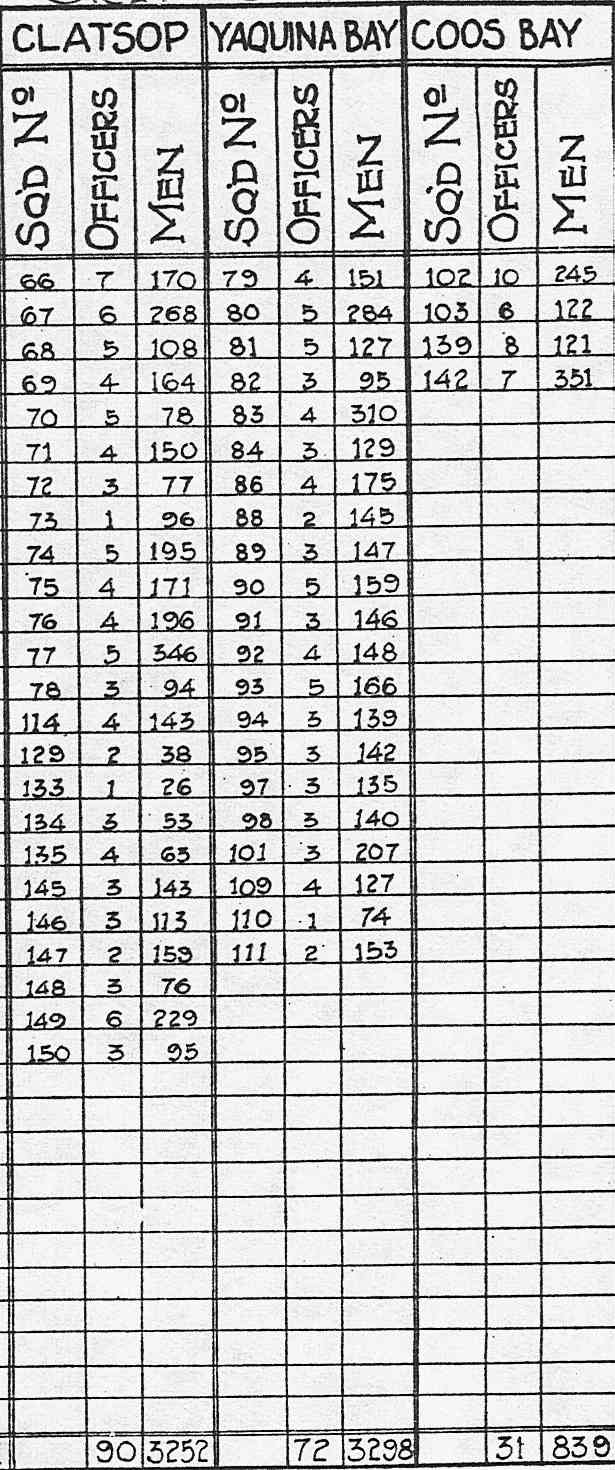

Go to the Spruce Units Listing
General stuff at:
Technical Information
Uses PaperMod theme of Hugo (see footer of this page)